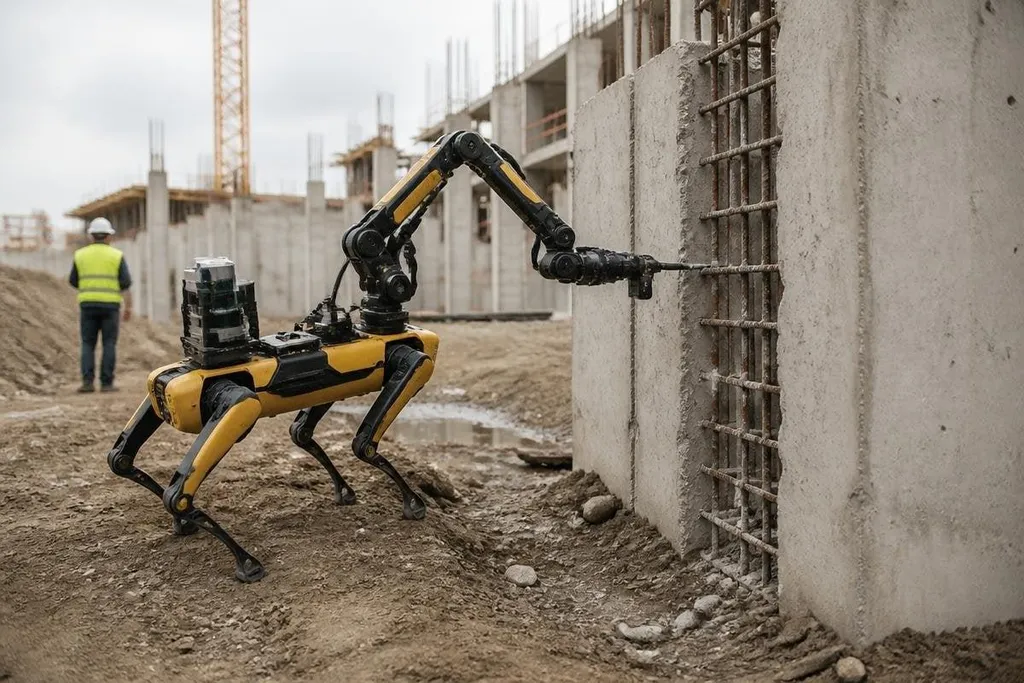
Construction robots are moving toward work that depends on changing ground, unfinished buildings, and people nearby. The most useful progress will come from machines that can repeat hard tasks safely, show their limits, and fit existing site work.
- Robots that place, scan, or move materials without a fixed factory setup
- Better links between site robots, building models, and human supervisors
- Proof that a machine can work through dust, uneven ground, weather, and delays
Robots that work on changing ground
A factory robot repeats the same motion in the same place. A construction robot faces ground that changes by the hour, with loose material, slopes, gaps, and tools left in its path. That makes sensing and motion control as important as the arm or wheels.
The machines worth watching will use cameras, LiDAR, or other sensors to build a live view of the site. LiDAR measures distance with laser pulses, helping a robot detect walls, vehicles, trenches, and people.
The useful test is not whether a robot can move through an empty work area. It is whether the robot can stop, reroute, or ask for help when the site changes.
That matters to a site manager because a stopped machine can block a crew or delay a delivery. A robot that reports why it stopped is easier to place into daily work than one that only works during a clean demonstration.
Construction tasks with a clear payoff
The strongest candidates will handle jobs with repeatable motions and a clear safety cost. Material movement, layout marking, surface finishing, drilling, inspection, and site scanning all fit that pattern, but each needs a different machine design.
A mobile robot carrying supplies must deal with ramps, doors, and changing routes. A robotic arm placing material needs stable positioning and a way to detect a bad placement. A scanning robot needs enough battery life to cover the area and software that turns its readings into a useful site record.
The benefit depends on the handoff. If a worker must correct every movement, the robot may have shifted work rather than reduced it. If the machine records where it worked and flags uncertain results, the crew can check the small number of places that need attention.
A construction site changes during the job, so an arm’s accuracy doesn’t tell you how it handles a new plan or a blocked route. Robot 24 can connect construction robot claims with the machine and software shown in the report. That sets up the next question: can the software keep the arm useful when site conditions change?
The software link may matter more than the arm
Construction sites already use digital building models, laser scans, schedules, and inspection records. A robot becomes easier to manage when it can read the same data and return results in a format the project team already uses.
That connection can start with a basic task: receive a work area, complete a scan, and mark points that need human review. The system should record the robot’s path, sensor readings, stopped periods, and operator actions. Those records give a project team something it can check after the work is done.
Remote control will remain part of this process. A worker may guide the robot through an unusual section, then let its software repeat the known motion. The open question is how much supervision each task needs after the first pass. A claim of autonomy means little without that number.
What still needs proof
No source material was supplied for named products, deployments, prices, dates, or measured results. That limits any honest ranking of current construction robots. A watchlist should therefore focus on evidence, not a long list of company claims.
The strongest proof would include a live worksite, a defined task, a recorded failure rate, and a clear account of human involvement. It should also state the ground conditions, weather, shift length, battery changes, and repair time. Without those details, a smooth video shows control of the demo rather than useful site performance.
Before a pilot, check these points:
- Task boundary: Write down the exact job, surface, material, and finish standard.
- Human control: Record when an operator must guide, approve, or recover the robot.
- Site fit: Check doors, ramps, dust, rain, lighting, network coverage, and charging space.
- Failure record: Ask how often the robot stops and what workers do next.
- Data handoff: Confirm where maps, images, measurements, and work logs go.
- Cost record: Count setup, training, supervision, repairs, and idle time.
I'd watch the machines that publish these details, even when the numbers expose a weak result. Construction robotics will earn trust through repeatable site records, not a short clip of a robot finishing one clean task.
The next useful benchmark is simple: one defined construction job, repeated across changing sites, with the robot’s stops and human interventions counted.